
Montana Educator of the Year lays foundation for success in special education
HILARY MATHESON | Hagadone News Network | UPDATED 6 hours, 49 minutes AGO
EDUCATION REPORTER Hilary Matheson covers education for the Daily Inter Lake. Her reporting focuses on schools, students, and the policies that shape public education across Northwest Montana. Matheson regularly reports on school boards, district decisions and issues affecting teachers and families. Her work examines how funding, enrollment and state policy influence local school systems. She helps readers understand how education decisions affect students and communities throughout the region. IMPACT: Hilary’s work provides transparency and insight into the schools that serve thousands of local families. | November 21, 2026 11:00 PM
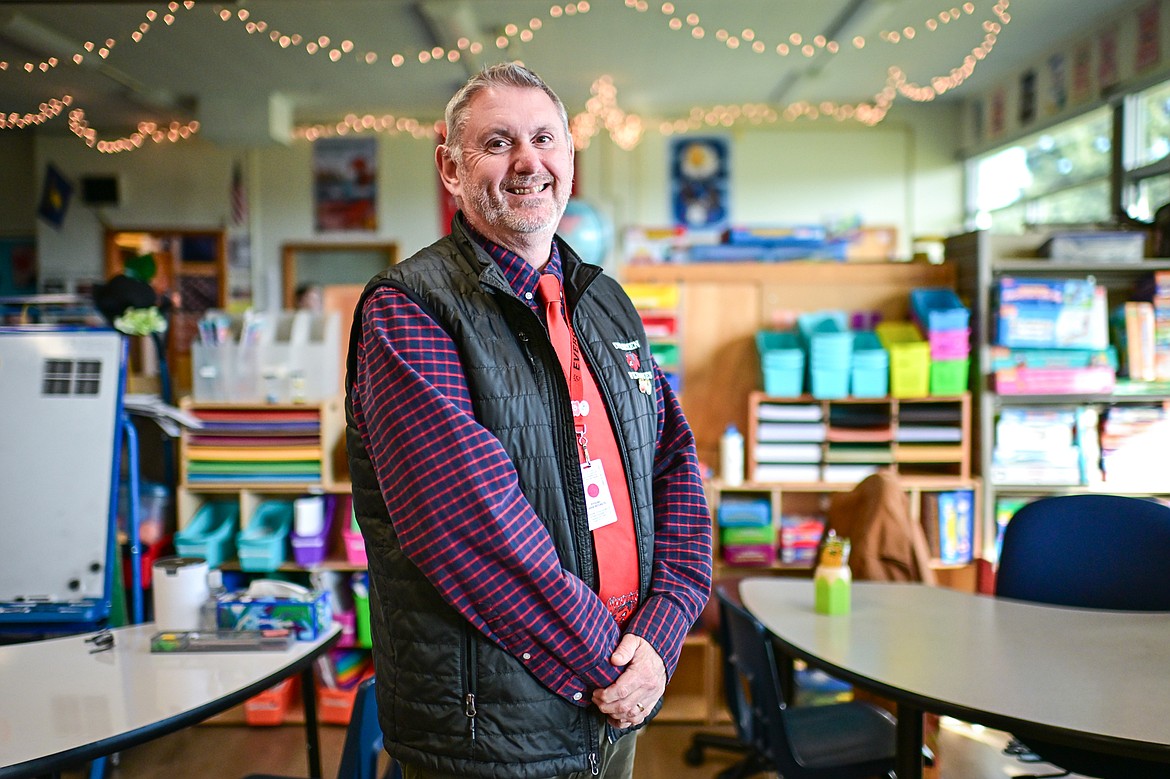
Montana Educator of the Year Kenny Ross' teaching career spans 30 years and three countries — Scotland, England and America, where he's in his third year teaching special education at Evergreen Junior High.
"To me, being a teacher is about much more than teaching a curriculum or delivering lessons. It's about recognizing potential in every student, sometimes even when they don't yet recognize it in themselves," Ross said.
On a sunny November morning, the spectacled Scot, who is quick to smile and tell a story, gave a tour of the junior high foundations classroom where he teaches six periods a day to nine students.
Opening the door, sunlight streamed from a window-lined wall where the fifth- through eighth-grade students have a view of the mountains as they tackle the school day.
"I explain to them what foundation is. You need to put the foundations down so we can build something. And the reason you're here is because you need some extra support, and we're going to build. Your extra support is going to make you build and give you the skills you need," Ross said.
AT 10:20 a.m., students filed into the classroom after P.E. to start third period, reading. One student took a seat in a hammock chair in the section of the classroom where a variety of tactile and sensory manipulatives are neatly organized on shelves and walls. In addition to the hammock chairs, there is other movement-friendly seating, along with beanbags and floor cushions and a calming corner for students who need a moment to decompress.
The rest of the students continued to the other side of the classroom, which can be separated by a divider. There, they retrieved books and word searches and took a seat at different tables to start working on reading and vocabulary with Ross and paraeducators Jay Aiken and Hillery Eastman. Seventh grader and teacher's aide, Ary Zanca, later arrives to work one-on-one with a student who opens a book and starts to read out loud.
Eastman started working in the foundations classroom five years ago, starting out as a long-term substitute.
"The program that Mr. Ross has set up in this room has made staying here worthwhile," Eastman said, noting his humor and ability to pivot to a different approach or new task during a lesson. "...which is so important for these kids. If they're getting frustrated, you don't want to keep hammering home the same thing over and over again. Use a little bit of a sense of humor and try to approach it from a different perspective, and that is what Mr. Ross is most excellent at doing."
Instruction is guided by each student’s legally required individualized education plan (IEP), which outlines and tracks measurable academic and functional goals, supports and accommodations for students with disabilities to progress in their learning.
IEPs are developed by a team that includes parents, which allows Ross to build relationships with families to stay on the same page, which helps build consistency between home and school. Often, when students graduate from junior high, Ross will stay in communication with families to see how they're doing.
The tailored plans mean students are often working at different grade levels, which may vary depending on the subject, according to Ross. In addition to academic goals, social emotional, independence and communication goals are incorporated into IEPs.
"We're looking at where they're at. We take data, we review it quarterly and then set new goals the next academic year," Ross said.
WORKING WITH students who have different cognitive/physical disabilities, Ross seeks to deliver clear expectations and rules in multiple ways. At the front of his classroom, for example, are two whiteboards. One outlines voice level expectations written out in numbers and words from 0 "no talking total silence" to 4 "playground outside voice" and then specified with the tap of a small circular light under each designation.
Classroom routines generally follow the school schedule, with breaks and adjustments as needed. Academic instruction is paired with life skills such as brushing teeth, budgeting, cooking and shopping.
The other whiteboard is divided into sections by each period that is broken down to a question and an "I can" and "I know" statement such as: "I can answer questions about the story and I know letters and their sounds," for example, along with the day's agenda.
To help students track their progress and keep them motivated throughout the school day, Ross gives them punch cards with reward incentives that students pick. Students also have various jobs in the classroom, such as feeding the fish in two tanks, which Ross incorporated into a science lesson when they discovered a surprise.
"We started with three fish ... And then the fish started breeding and we got over 50 fish, so we did a project with it," he said.
With an overabundance of fish, the students took a trip to an aquarium shop where they sold and traded fish to stock a second tank in the classroom.
Outside of the classroom, students regularly go on field trips, attend assemblies and compete in Special Olympics. The class will be gearing up for snowshoeing in February to compete in the winter games in March.
"I think one of the most important things we do as educators is create opportunities for students to experience success. For some students, that might be mastering a difficult academic concept. For others, it might be communicating a need independently, making a purchase in a store, or completing a daily routine without support. Those achievements are equally important," he said.
ROSS STARTED his career in Scotland in 1996, teaching secondary school history (ages 11-18). He didn't transition into special education until after relocating to Whitefish.
Getting to Montana was quite an endeavor. His wife, who had previously lived in Whitefish and had citizenship, made the move first with their two children.
Ross was set to fly out in April 2020, when the COVID-19 pandemic hit. As the borders closed, his visa expired.
"I had given up my teaching job in the U.K. in December 2019, put my house on the market, sold the house and I couldn't come over. Luckily, the people that bought the house were buying to rent so they said I could stay there," Ross said.
In the meantime, he took another job, checking for any updates on the borders daily. When borders partially reopened, Ross said he was one of the first in line to meet with immigration officers.
With everything in flux, he eventually secured a flight and arrived in Montana in July 2021. However, he had to wait another year for his green card to be reissued to receive the required teaching credentials from the state. Rather than putting his career completely on hold, he started volunteering in Whitefish School District before taking a position as a behavior specialist.
Once he received his history endorsement, he found that high school history teaching jobs were scarce in the valley. Then, he saw a special education teacher opening at Evergreen School District and started researching how to get his special education endorsement. During a Montana Council for Exceptional Children Conference, he was connected to Evergreen School District Special Services Director Melissa Hardman, who, he said, recognized him as a soccer referee. Soccer is his other passion and he has published books about the sport.
During the conference, the University of Montana held a session on the Specialized Interventionists for Montana Schools program, better known as SIMS Scholars, which fully funds two-year programs in order to increase the number of special education teachers and speech-language pathologists working in Montana, which faces ongoing shortages.
When he got home, he applied, was accepted and enrolled in the university where he is currently completing a master's degree and recently received the University of Montana College of Education Marlene Bachman Award for Student Teaching.
"It's hard work," Ross said. "It's hard work in terms of, you've got to write IEPs and there's a lot of extra paperwork and stuff. And I think you've got to have good time management. You've got to have good organizational skills."
His advice to avoid burnout is to "reset every day."
"Because there might be a frustration with a kid who just doesn't get it. They're working on, say, a math problem, and they just don't get it. And we try different strategies and stuff, and you just reset and go, hey, we didn't get it yesterday. We're going to start again today. Let's see if we can make a breakthrough today and get it," Ross said.
Leaving Ross' classroom, posted on the wall next to the door underneath the "Pledge of Allegiance" is the foundations classroom pledge: "I am a kid with hope. I am talented, smart and capable of success. I have dreams for the future and work hard to reach them. I will try my best and be kind every day."
"To me, being a teacher is about much more than teaching a curriculum or delivering lessons. It's about recognizing potential in every student, sometimes even when they don't yet recognize it in themselves," Ross said.
Walking a visitor out to the parking lot, Ross looked back at the school building.
"I've found my calling," he said.
Reporter Hilary Matheson can be reached at 406-758-4431 or [email protected]. If you value local journalism, pledge your support at dailyinterlake.com/support.
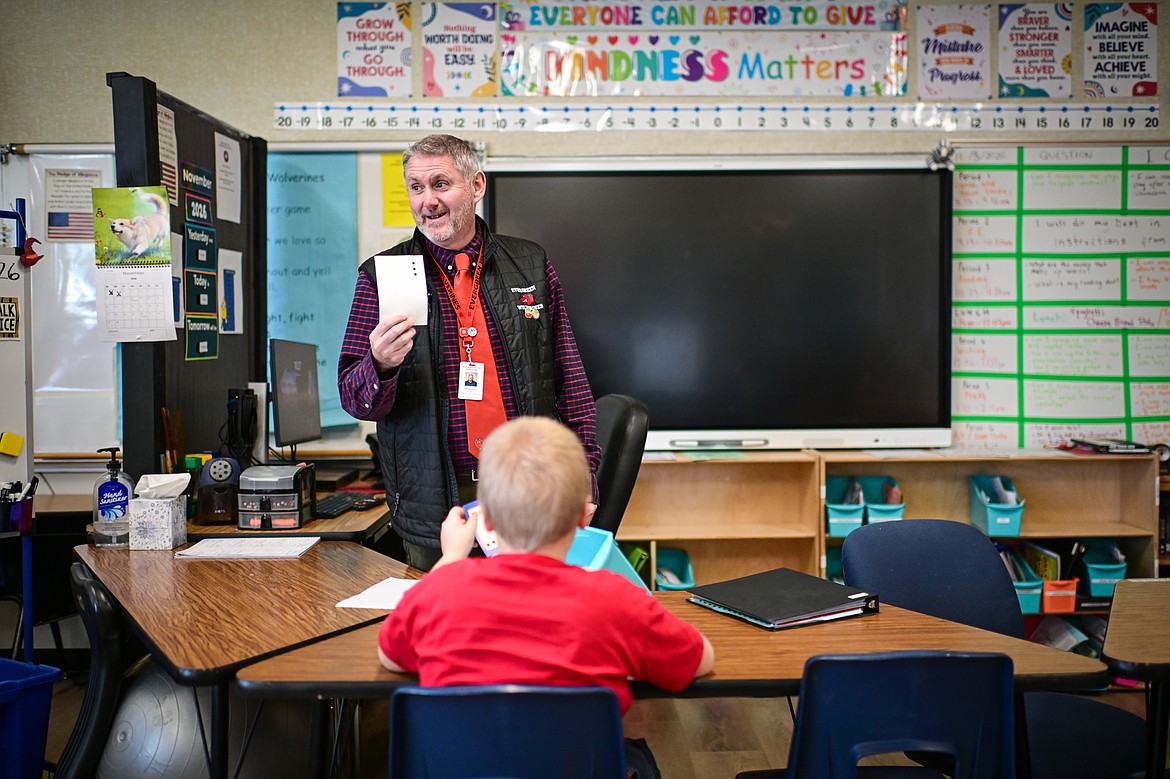
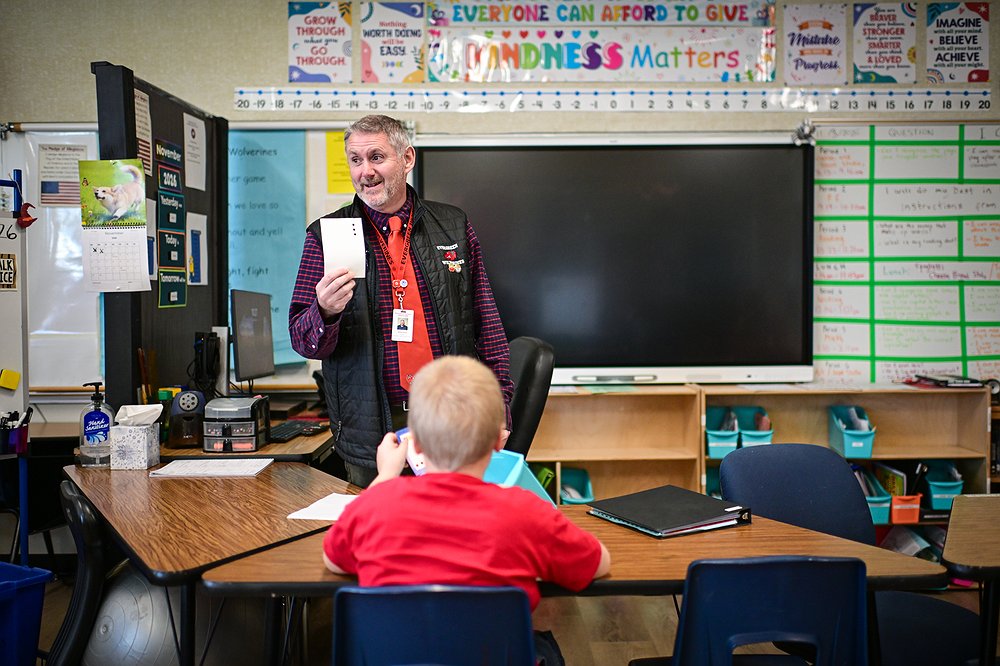 Evergreen Junior High special education teacher Kenny Ross instructs his class on Tuesday, Nov. 3. (Casey Kreider/Daily Inter Lake)
ARTICLES BY HILARY MATHESON
Whitefish and Columbia Falls speech and debate teams place in the top three at Hamilton tourney
The Whitefish High School speech and debate team placed second, and Columbia Falls High School, third, at a Saturday tournament in Hamilton.
Montana Educator of the Year lays foundation for success in special education
Montana Educator of the Year Kenny Ross' teaching career spans 30 years and three countries — Scotland, England and America, where he's in his third year teaching special education at Evergreen Junior High.
Helena Flats School fundraises to replace aging playground
Helena Flats School is fundraising to replace its nearly 40-year-old playground with safety and wheelchair accessibility and the broader community in mind.