
Spirit Lake CUP denial upheld
CHLOE COCHRAN | Hagadone News Network | UPDATED 3 hours, 23 minutes AGO
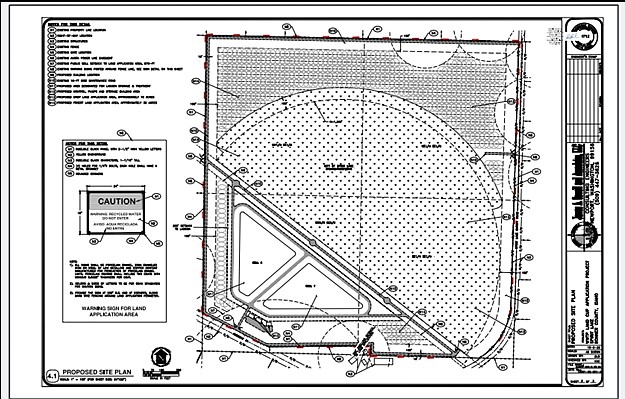
Proposed treatment plan
Courtesy of BONNER COUNTY PLANNING DEPARTMENT
SPIRIT LAKE — In a majority vote, Bonner County commissioners upheld the denial of a conditional use permit for an expanded wastewater treatment facility for the city of Spirit Lake, following a six-and-a-half-hour land use hearing on the city's appeal. Commissioners found the proposal did not meet the requirements outlined in the Bonner County Revised Code.
The denial was upheld by commissioners Asia Williams and Brian Domke, both heavily citing insufficient evidence of safety for the proposed use, among other findings. The pair discussed the intent of the conditional use permit — to expand a wastewater treatment facility for the city of Spirit Lake utilizing property in Bonner County — and whether it was adversely safe for Bonner County residents.
"I've looked at this for a number of months. I'm not an elected representative for Spirit Lake, and for me, my job is to look at the Bonner County Comprehensive Plan, the Bonner County Ordinance, and the Bonner County residents," Williams said. "And I understand that Spirit Lake, essentially, is saying it is more cost-effective for Kootenai County residents to do the method that they're proposing. But for me, I do see it at the expense of Bonner County residents, because nowhere does anybody say, 'I would like to live next to it.'"
The argument was made heavily during the public comment portion of the hearing, where nearby property owners felt Spirit Lake should address its wastewater needs within Kootenai County, to avoid Bonner County residents bearing the risks of the expansion without reaping any of the rewards from it.
Domke noted that it could be common for public utilities to span across county lines but noted that his overall lack of approval for the CUP stemmed from safety concerns and a lack of Idaho Department of Environmental Quality's approval of the proposed site use. He said that despite the applicant's claims that DEQ couldn't approve the planned use without the CUP approval, he was unable to ignore his duties to follow the county's code just because of another agency's process.
"The lack of a DEQ agency comment or an approved wastewater facility plan, or any kind of formal documentation from DEQ, letting us know that they believe this proposal will not create a hazard, will not be dangerous, that's problematic for me," Domke said.
Commissioner Ron Korn carried mostly a dissenting opinion on the file from the other commissioners. Korn believed the file should be strictly evaluated against Bonner County Code, not against opinion or who the applicant of the file was. Though he said he understood public concerns, Korn said there wasn't enough evidence in the file that the proposal violated county code.
"I do believe that the adverse impacts that the people have concerns about, I believe the applicant did show on the record that they would be minimized,” Korn said. "According to DEQ, they don’t even require a buffering area, and they’re (applicants) willing to put in 100-foot buffering on their own, so I find that they’re actually doing more than what DEQ is even requiring them to do.”
Public testimony for the file was lengthy, with neighboring property owners, and several children, listing concerns of odor control, noise, environmental risks and impacts to nearby homes, outside of the belief that the expansion should occur in Kootenai County.
"Our property touches the corner of where they want to put the sewer lagoon. If you put the septic water there, then you are harming a lot of animals' habitats. And septic water is a public health hazard for animals and humans. And if your house is where our house is, would you put the septic water there? If I were you, I would let Kootenai County put their septic water in their own county, not ours," one young participant said.
Another testified, shedding light on the potential odor that may come from the treatment center in relation to his experience with toxic odors while serving in the U.S. Navy. Because of those different exposures, the man said his family is still paying the price with their health. His testimony encouraged Spirit Lake to upgrade its wastewater system with modern technology, instead of what was proposed, and to do so in Kootenai County.
"Modern sewage treatment plants have evolved from these basic disposal systems to sophisticated facilities that focus on resource recovery and environmental protection; the city of Spirit Lake owes it to the community to invest in a modern, responsible sewage treatment facility within Kootenai County, not a high-risk, outdated system in Bonner County," the man said.
The permit was originally denied in a unanimous vote by the Bonner County Zoning Commission in February after commissioners believed the proposed plan would cause harm to neighboring properties, citing a 20-30% decline in property value if the CUP was approved.
Applicants of the file, the city of Spirit Lake, later appealed the denial, arguing that the unanimous denial of the file was not supported by substantial evidence on the record, and that the decision was in violation of constitutional or statutory provisions.
The city contended that a zoning commissioner used a computer to look up financial impacts of property value near the sewer treatment plant during deliberation of the file, using this information to make a decision.
“The record demonstrated that this ‘study’ was introduced after the close of public testimony and after the evidentiary record had been established,” Spirit Lake officials said in their appeal. “The commission deliberated extensively on property value impacts without identifying supporting evidence in the record. Staff explicitly advised the commission that such evidence was required. Only after that point did a commissioner independently locate and introduce a study during deliberations.”
Appellants argue that obtaining information outside the hearing process deprived the applicant of an opportunity to speak on the matter, a process that they said is fundamental in the hearing process.
Despite those arguments, Bonner County commissioners upheld the Zoning Commission’s denial in a majority vote.
ARTICLES BY CHLOE COCHRAN

Technology concern delays family court office allocation
An agreement to allow the First District Court to utilize county-owned office space for its family court services is slowly running out of time as Bonner County commissioners have yet to approve an allocated space for the service.

Spirit Lake CUP denial upheld
Permit would have allowed expanded wastewater treatment facility
In a majority vote, Bonner County commissioners upheld the denial of a conditional use permit for an expanded wastewater treatment facility for the city of Spirit Lake, following a six-and-a-half-hour land use hearing on the city's appeal. Commissioners found the proposal did not meet the requirements outlined in the Bonner County Revised Code.
Spirit Lake CUP denial upheld
In a majority vote, Bonner County commissioners upheld the denial of a conditional use permit for an expanded wastewater treatment facility for the city of Spirit Lake, following a six-and-a-half-hour land use hearing on the city's appeal. Commissioners found the proposal did not meet the requirements outlined in the Bonner County Revised Code.