Post Falls police chief against banning ALPRs
JACK DEWITT | Hagadone News Network | UPDATED 1 month, 1 week AGO
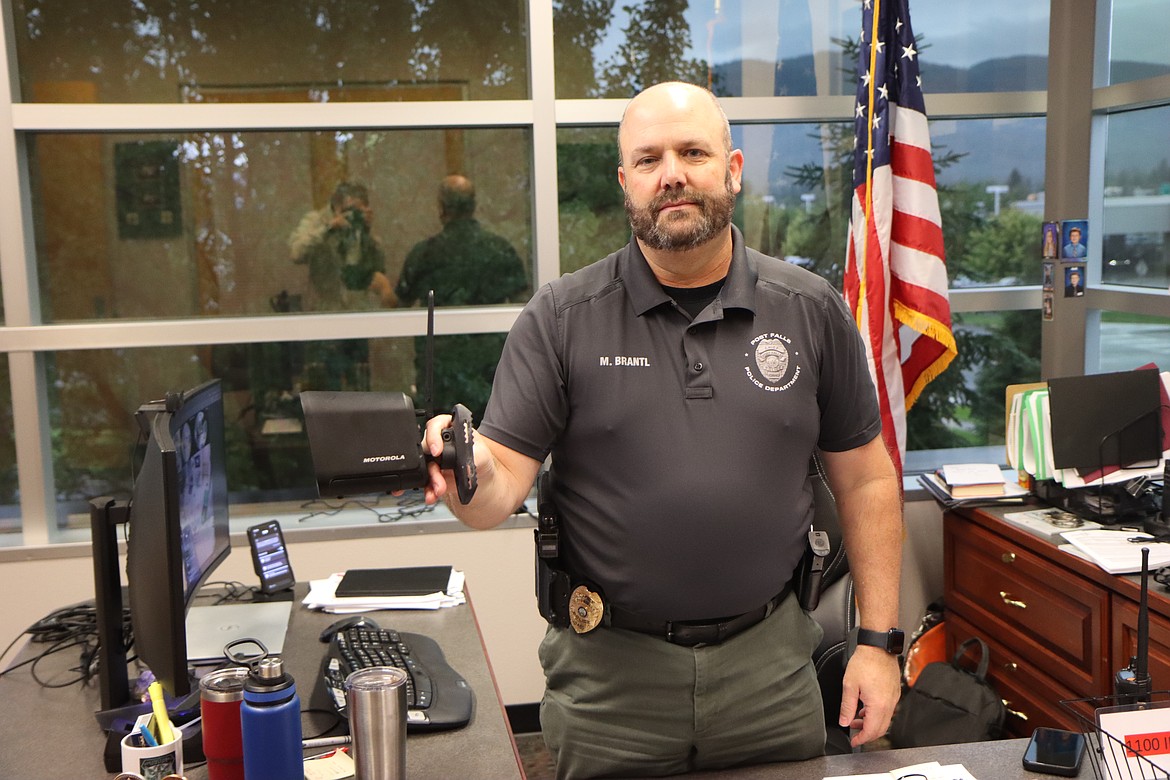
Post Falls Police Chief Mark Brantl showcases one of Post Falls' Motorola Automatic License Plate Readers.
JACK DeWITT/Press
Conversation around Flock, ALPRs, and their data is at an all-time high. Proponents of the technology tout its investigative capabilities, while opponents warn of expanding public surveillance and technological limits.
Many are calling for an outright ban on ALPR technology, but Post Falls Police Chief Mark Brantl said such a decision could have serious repercussions. The Post Falls Police Department has been using ALPRs since 2007.
This marks almost two decades of the technology’s integration into the department, and without it, Brantl warned, “We will not have the same investigative results without this tech.”
Post Falls has 10 Motorola ALPRs, although five of them are not currently active while Brantl awaits legislative decisions. Brantl said the ALPRs are limited in scope.
“They’re only looking at public right-of-ways,” he said. “Where the court has been very clear, you have a diminished expectation of privacy.”
Brantl said the ALPRs are placed and pointed so they can only view the backs of cars as they drive past. He said the ALPR captures only a photo of the rear of a vehicle. He said that with advancements in A.I., the technology can now also identify the make, model and color, and even bumper stickers, of a vehicle captured in a photo.
He provided a real-world example of how the department uses ALPRs while highlighting their investigative value: cameras at a car dealership captured a break-in attempt, and the suspect fled in a white Ford Raptor. Officers queried the ALPR database for vehicles matching the description captured on the city's ALPRs during the break-in.
“It brought up a list and said, 'OK, these are all the Raptors,' and it gives us a place to start looking,” he said.
Using the example, he reiterated the tool's value to the department.
“We will not be as effective as we could be with this data, with this technology,” he said.
Brantl firmly rejected comparisons to other departments' use of ALPRs to identify drivers, ticket speeders, and capture failures to stop.
“We don’t use it, we are not even thinking about using it,” he said.
Access to ALPR data is tightly governed. Only authorized users can access ALPR data and must complete training that reinforces that the data is criminal justice information, not for personal use.
“You don’t use databases to search your girlfriend, your boyfriend, your mom, your dad, your kids,” Brantl said. “You get in trouble, you get fired, and you can get charged for doing that.”
Under Idaho’s 2025 Senate Bill 1180, queries within the system require a case number for data to run. Not only that, but the type of case matters as well. Queries can only be run on misdemeanors, felonies, traffic accidents or missing/endangered persons. All of which Post Falls’ Internal Affairs investigator audits multiple times a year. Brantl himself doesn’t have clearance, something he doesn’t even want.
"Why do I need it? I'm not doing investigations,” he said.
Opponents of the technology worry most about how ALPR data is stored. Concerns that the City of Post Falls and the PFPD also share. Under municipal code and county policy, the images are treated as public records and must be kept for two years. Brantl prefers a shorter period.
“There’s no reason to be holding on for two years. Thirty days, 60 days, that’s more of the butter zone,” he said.
In a statement released in July, Post Falls Mayor Randy Westlund publicly called on state legislators to require the disposal of ALPR data after 90 days, not only to diminish the ability to make a “tracking database” but also to require jurisdictions actually to get rid of the data. Westlund said some jurisdictions never get rid of it, leaving the door open for “myriad” privacy concerns.
Post Falls owns the data captured by its ALPRs outright and chooses to share it only with other Idaho law enforcement agencies. Brantl said Post Falls does not share ALPR data with any federal agencies or out-of-state entities.
The data captured is stored in a Motorola cloud that Motorola itself does not have access to. Brantl said that should legislation around data storage be updated, Post Falls can change data retention with a “simple” change.
Brantl distinguished ALPR queries from cellphone location data, which require warrants. Brantl said ALPR data is “more of a surgical database” that can be accessed during an investigation. Opponents of ALPRs have floated the idea of requiring a warrant to access ALPR data, a concept Brantl thinks is not “practical at all.”
“How do I go in front of a judge and say, ‘I need a warrant to search this database for a general vehicle,” just to give me a list of people it could’ve been?” he said.
Looking ahead, Brantl framed ALPRs as one piece of broader technological progress — alongside body cameras, AI-assisted report writing and even drones — that can improve human efficiency while still bringing human judgment, discretion and empathy to police encounters.
“We come into contact with people on some of their worst days,” he said. “You have to be able to connect with victims, and sometimes even suspects. A.I. just can’t do that.”
Ultimately, he said, elected officials will decide the technology's fate.
“They are a valuable tool in law enforcement. They are not violating any law. They are not violating a constitutional right,” he said. “But the people that make the policies, which are elected officials, ultimately, it’s going to be their decision.”
The department’s ALPR policies and procedures are posted on the city website for the public to view and will be updated as changes occur. Brantl’s message remains consistent: the systems capture rear plate and vehicle images on public roadways under strict legal and procedural limits that work to prevent misuse and provide measurable investigative benefits.
“It is not taking pictures of the occupants. We do not use facial recognition; we do not use any type of Bluetooth sniffers. It’s just, literally, taking a picture,” Brantl said.
ARTICLES BY JACK DEWITT

Little leads in fundraising
Idahoans are primary donors to gubernatorial candidates

Local seniors sound off on Social Security increase
Some say it will increase Medicare premiums