
High court upholds murder conviction in deadly 2022 home invasion in Kalispell
DERRICK PERKINS | Hagadone News Network | UPDATED 1 month AGO
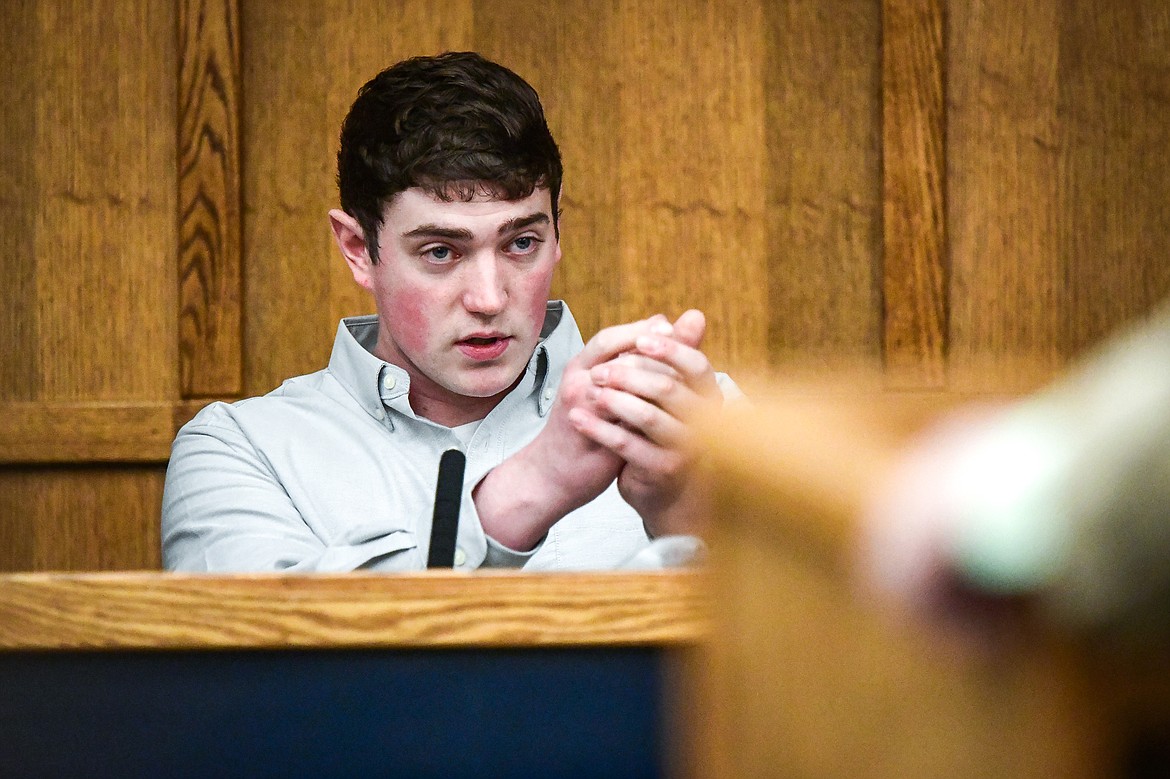
Zackary Matthew Maas testifies about the act of shooting Gabriel Wagoner during his deliberate homicide trial in Flathead County District Court on Wednesday, March 15. (Casey Kreider/Daily Inter Lake)
NEWS EDITOR Derrick Perkins serves as News Editor at the Daily Inter Lake. He oversees daily news coverage and works closely with reporters to plan, edit and publish stories across print and digital platforms. Perkins helps coordinate coverage of local government, public safety, business and community developments throughout Northwest Montana. He works with the reporting staff to strengthen journalism while maintaining consistent daily coverage. His role helps ensure the newsroom delivers timely, accurate reporting that readers rely on. IMPACT: Derrick’s work keeps readers informed about the decisions and events shaping their communities every day. | September 17, 2026 12:05 AM
The Montana Supreme Court has upheld the deliberate homicide conviction of Zackary Matthew Maas in the 2022 shooting death of Gabriel Wagoner in Kalispell.
In a majority opinion released Tuesday, Chief Justice Cory Swanson wrote that while Judge Dan Wilson and the prosecution erred at several points during Maas’ 2023 murder trial, the evidence still pointed to his guilt. In a dissenting opinion, Justice Katherine Bidegaray wrote that at least one of the errors necessitated a new trial.
Although Maas argued self-defense, a Flathead County District Court jury found him guilty of deliberate homicide on March 16, 2023, following a trial that spanned several days. County Attorney Travis Ahner prosecuted the case alongside Deputy County Attorney Ashley Frechette.
Maas, according to witness testimony and court documents, shot a bat-wielding Wagoner after Maas and a friend broke into Wagoner’s Kalispell home in the early morning hours of March 13, 2022. The crux of the case centered on whether Maas was justified in shooting Wagoner, who he claimed was about to swing a bat at Maas’ accomplice in the home invasion.
Wagoner succumbed to his wounds at Harborview Medical Center in Seattle several weeks later, but not before sharing portions of his account with first responders, investigators and relatives.
Appealing the conviction, Maas’ Missoula-based attorney, David Maldonado, argued that allowing testimony from Wagoner, either on recordings or through witnesses who recalled speaking to him before his death, violated Maas’ right to confront his accuser in court.
In the Sept. 15 decision, the Supreme Court justices agreed that allowing the use of Wagoner’s statements to a Kalispell Police detective investigating the case into trial was an error. Made after the shooting and on the same day that authorities arrested Maas, Wagoner’s remarks to the detective “were likely to be used in court,” Swanson wrote.
But the only standalone information provided by Wagoner via the detective — the pace at which Wagoner was moving up the stairs of his apartment when the gun went off — was harmless given the rest of the evidence and testimony about the shooting.
“The detail was ultimately insignificant to the state’s case because the argument boiled down to whether the jury believed Maas was justified in shooting Wagoner if he used or threatened to use force to evict his intruders,” Swanson wrote.
How quickly Wagoner moved up the stairs carried little weight when put alongside the “evidence of Maas’s numerous and explicit threats to Wagoner, Maas’s armed entry into Wagoner’s home in the middle of the night, the physical evidence of the confined staircase, and ultimately the state’s argument that Wagoner was legally justified in threatening or using force against the intruders if the jury believed that testimony,” the opinion states.
MALDONADO ALSO argued that the judge erred in allowing prosecutors to bring up Maas’ juvenile record, particularly an incident where an adolescent Maas shot a jogger with a BB gun, while cross-examining him on the witness stand.
Maas’ run-ins with the law as a minor were points of discussion preceding the trial, with Wilson ultimately ruling that Maas’ juvenile record was to remain out of the courtroom unless the defense first broached the subject. Montana law largely bars youth court proceedings from being used in adult trials.
But prosecutors argued during the trial that Maas opened the door to his criminal history as a youth when he described himself as a kind and peaceable person on the witness stand. They subsequently confronted Maas with the BB gun incident as the jury looked on.
The justices agreed that Maas’ testimony about himself permitted prosecutors to bring his juvenile record to light. They determined, though, that "the evidence was insufficiently relevant to Maas’s mindset as an adult and was unfairly prejudicial due to remoteness of time and the state’s failure to demonstrate a connection between the juvenile criminal conduct and Maas’s kind-hearted or non-violent character as an adult,” Swanson wrote.
Still, the justices found that the error was negligible given the evidence against Maas. They pointed to a string of threatening texts Maas sent to Wagoner before the shooting and messages he sent his friends indicating he planned to harm Wagoner and get revenge.
Given those messages and the other evidence, the justices questioned whether Maas was entitled to argue self-defense in shooting Wagoner during the home invasion.
“To the extent Maas was allowed to claim [justified use of force] ... it did not credibly hold up against the mountain of evidence against him, most of which was self-authored,” Swanson wrote.
IN HER dissent, Bidegaray argued that the use of inadmissible testimony via the detective who spoke with Wagoner before his death required a new trial.
Conceding that the information the jury gleaned from that testimony paled in comparison to the evidence against Maas, Bidegaray refused to rule out the possibility that it influenced the verdict.
“... A reasonable possibility remains that the constitutional error contributed to the jury’s rejection of the defense,” Bidegaray wrote. “The state therefore has not proved the error harmless beyond a reasonable doubt.”
Bidegaray agreed with the majority on the use of the BB gun incident during the trial. While prosecutors could rebut Maas’s description of his character, subsequent questions linked the childhood incident to the crime Maas committed as an adult, she wrote.
But because she already deemed the case in need of a new trial, she stopped short of determining whether the use of the BB gun incident required a reversal of the conviction.
Now 30 years old, Maas is serving an 80-year sentence at the Crossroads Correctional Facility, a privately-operated prison in Shelby.
News Editor Derrick Perkins can be reached at 406-758-4430 or [email protected]. If you value local journalism, pledge your support at dailyinterlake.com/support.
ARTICLES BY DERRICK PERKINS

Live updates: President Trump campaigns in Kalispell
Live updates from President Donald Trump's campaign stop in Kalispell.

Live updates: President Trump campaigns in Kalispell
Live updates from President Donald Trump's campaign stop in Kalispell.

Authorities identify suspect in deadly Kalispell shooting
One person is in custody after an early morning shooting in Kalispell on Tuesday left one dead and several wounded, authorities say.