
What Ephrata residents should know about the city’s new sign rules
NANCE BESTON | Hagadone News Network | UPDATED 12 hours, 50 minutes AGO
EPHRATA — More than a month after the Ephrata City Council unanimously approved an updated sign ordinance, city officials are encouraging residents, businesses and political campaigns to familiarize themselves with the new rules governing temporary signs.
The ordinance, approved Aug. 19, updates the city's sign code and is intended to improve safety, reduce clutter and provide clearer guidance on where temporary signs may be placed.
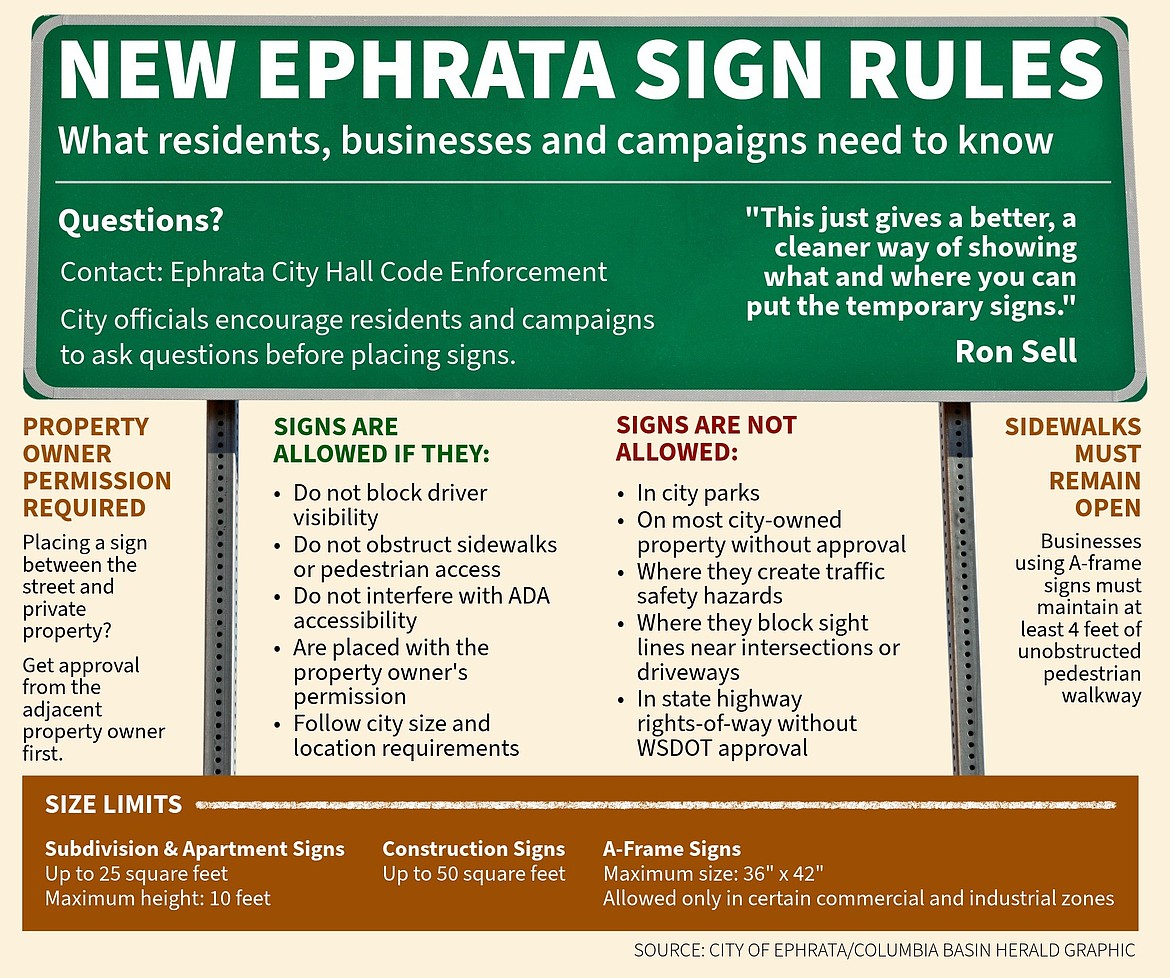
“This just gives a better, a cleaner way of showing what and where you can put the temporary signs,” Community Development Director Ron Sell said. “It's kind of more of a cleanup of where the signs can go because we were starting to get a lot of signs just all over.”
The ordinance applies to temporary signs, including political campaign signs, garage sale signs, real estate signs, grand-opening signs and other short-term displays. Permanent business signs are largely unaffected.
Under the code, signs cannot be placed in a manner that interferes with sight distance for motorists, pedestrians, driveways, parking areas or sidewalks. Officials said the changes were prompted in part by concerns about signs creating visibility issues at intersections, particularly during election season.
“There were some rather large campaign signs, particularly this year, that were put up, and we were kind of concerned that that could lead to some safety issues,” City Clerk Rob Miller said. “Everything that we do is generally oriented toward safety and quality of life for our residents.”
The ordinance also prohibits temporary signs in city parks and most city-owned property unless they are associated with an approved permit, special event or other city authorization.
“We do not allow them to go in the parks,” Sell said. “We don't want the parks to get covered in signs.”
Residents should also be aware that signs placed near private property require the property owner's permission.
“One other thing is that it does specifically state that if it's going between the street and a private property owner, especially in residential areas, they need to contact the property owner and have approval before they can place a sign,” Sell said. “That wasn't always the case in the past. Signs would pop up and nobody agreed to it.”
The code retains several specific size and placement requirements. Temporary subdivision and apartment-complex signs are limited to 25 square feet and 10 feet in height. Construction signs may not exceed 50 square feet. Portable A-frame signs are limited to 36 inches wide by 42 inches tall and may only be used in certain commercial and industrial zones.
Businesses using A-frame signs must also maintain at least four feet of unobstructed sidewalk space for pedestrians.
The ordinance does not regulate the message displayed on signs, city officials said, but rather focuses on where signs are placed and how large they can be.
“Because of First Amendment rights, what's on the sign we can't dictate,” Sell said. “But we do have the ability to limit the size and location.”
Although the ordinance is already in effect, officials said enforcement during the current election cycle will emphasize education and voluntary compliance rather than citations.
“We want to work with the folks that are putting the signs out and educate them rather than just writing fines,” Miller said. “We'll most likely just make phone calls and say, ‘Hey, can you move this? It's not in an appropriate place, but if you move it over to this location that would work.’”
Sell noted that many campaign signs currently displayed around Ephrata were installed before the ordinance took effect and are unlikely to be targeted for enforcement.
“A lot of the signs for this election have already been placed prior to approval of that sign code,” Sell said. “In most cases we're going to allow what's there to stay there. It'll be in the future, with anything new, where we're going to tell them what the code is now.”
Miller emphasized that the ordinance is not intended to prevent residents from expressing support for political candidates.
“This doesn't mean that you can't have a temporary sign in your yard to support your favorite candidate,” Miller said. “City council members were adamant about supporting people's right to visibly show their support for a particular candidate.”
City officials encourage anyone with questions about sign placement or compliance to contact City Hall or the Code Enforcement Department before installing a sign.
ARTICLES BY NANCE BESTON

What Ephrata residents should know about the city’s new sign rules
EPHRATA — More than a month after the Ephrata City Council unanimously approved an updated sign ordinance, city officials are encouraging residents, businesses and political campaigns to familiarize themselves with the new rules governing temporary signs. The ordinance, approved Aug. 19, updates the city's sign code and is intended to improve safety, reduce clutter and provide clearer guidance on where temporary signs may be placed. “This just gives a better, a cleaner way of showing what and where you can put the temporary signs,” Community Development Director Ron Sell said. “It's kind of more of a cleanup of where the signs can go because we were starting to get a lot of signs just all over.”

Indigenous teen still missing, may be in Soap Lake or Winchester area
EPHRATA — The Grant County Sheriff’s Office is continuing to investigate the disappearance of 16-year-old Kioni Oman and requested a Missing Indigenous Person Alert through the Washington State Patrol Tuesday.
Sheriff’s race Q&A part 3: candidates outline unpopular decisions they may face
EPHRATA — As Grant County voters prepare to choose their next sheriff, they are weighing not only each candidate's vision for the department but also how they would handle difficult decisions that may draw criticism from employees, elected officials or members of the public.