
Bill seeks to streamline border crossings for tribal members
HAILEY SMALLEY | Hagadone News Network | UPDATED 7 months AGO
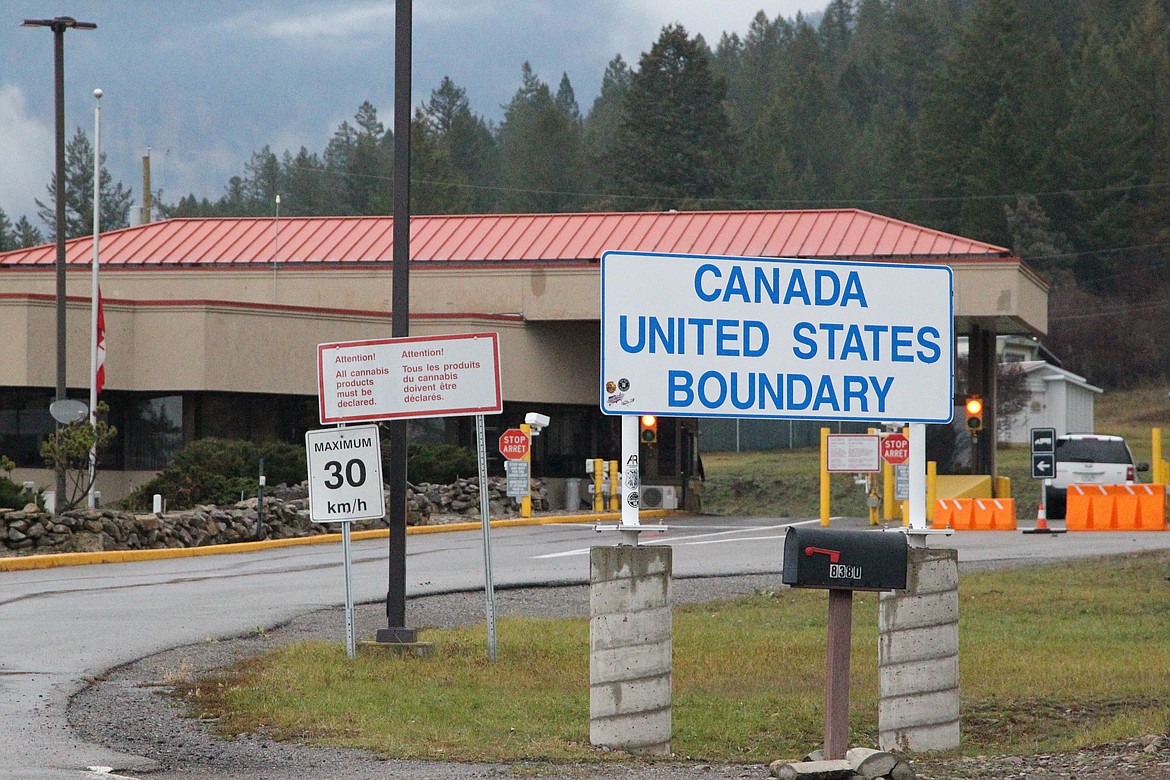
The border between the United States and Canada north of Eureka. (Will Langhorne/The Western News FILE)
Enrolled tribal members may soon be able to freely cross the U.S.-Canada border as several federal representatives call for the repeal of a little-known federal law centered around the controversial concept of blood quantum.
In 1794, the Jay Treaty cemented the right of indigenous people to freely cross the border between the United States and Canada, but an oft-overshadowed section of the Immigration and Nationality Act of 1952 introduced new conditions for citizens looking to exercise that right, including that they “possess at least 50 per centum of blood of the American Indian race.”
Legislation sponsored by U.S. Sen. Steve Daines, R-Montana, aims to dismantle that requirement in favor of a more lenient system that relies on proof of tribal citizenship. Daines joined a bipartisan coalition of senators to introduce the measure July 31, stating that the blood quantum requirement was “nothing but a hindrance” for tribal communities in Montana.
“By eliminating this requirement, we can help restore tribal sovereignty and ensure members of Montana’s tribal communities can freely exercise their right to travel across the U.S. and Canada,” Daines stated in a press release.
The right to navigate the border is especially important for transboundary groups like the Ktunaxa Nation, which encompasses four Indian bands in Canada, the Confederated Salish and Kootenai Tribes in Montana and the Kootenai Tribe of Idaho. While tribal governments are split by the international and state borders, all six groups share a language, cultural traditions and familial ties.
“I’m not Canadian and I’m not American,” explained Heidi Gravelle, the chief of the Tobacco Plains Indian Band, one of the four member bands in Canada. “I’m a Ktunaxa.”
The Tobacco Plains Indian Band currently governs a 10,600-acre reserve between Roosville and Lake Koocanusa in British Columbia, adjacent to the U.S.-Canada border. Gravelle grew up on the reserve, but she attended primary and secondary school in Montana, something she said still happens today. As an adult, Gravelle often finds herself traveling into the U.S. to visit family or spend time in the Ktunaxa Nation’s traditional homelands, which include parts of Montana, Idaho, Washington, Alberta and British Columbia.
“Our existence as First Nations people is tied to our land base,” said Gravelle. “Having access to our lands is so important.”
Gravelle argued that the blood quantum requirement made it harder for both tribal members and border patrol agents by introducing the need for additional paperwork at border crossings. Not all tribal members have passports, Gravelle pointed out, and the process to obtain one can be long and arduous. By comparison, most tribal members already have documents that show their enrollment status.
The current law is also exclusionary to some members, as the Tobacco Plains Indian Band, like many First Nations in Canada, does not use blood quantum as a metric for citizenship.
Gravelle described the idea of blood quantum as “outdated and colonial.” First introduced by the United States Bureau of Indian Affairs in 1884, the process relies on simplified understandings of genetics and race to determine how much “Indian blood” an individual has.
About 70% of federally recognized tribes in the U.S. still use blood quantum to determine whether individuals are eligible for enrollment, but the specific requirements vary. Of the seven federally recognized tribes with reservations in Montana, the Chippewa Cree Tribe of Rocky Boy is the only tribe that requires members to meet a 1/2 blood quantum.
The proposed legislation would replace the blood quantum requirement with language that encompasses all enrolled members in tribes in the U.S. and First Nations in Canada.
Daines sponsored a similar bill during the previous legislative session. That effort failed to gain traction and ultimately died in committee without a hearing.
The current bill is co-sponsored by Sens. Kirsten Gillibrand, D-NY; James Risch, R-ID; Amy Klobuchar, D-MN; Mike Crap, R-ID; Tina Smith, D-MN; and Patty Murray, D-WA. A bipartisan coalition of representatives is sponsoring a matching initiative in the House.
Both bills have been assigned to the respective Committees on the Judiciary. Neither have been scheduled for a hearing.
Reporter Hailey Smalley can be reached at 406-758-4433 or [email protected].
ARTICLES BY HAILEY SMALLEY
Winging it through winter: Rare Anna's hummingbird finds shelter in Bigfork backyard
The bird turned out to be an Anna’s hummingbird — a rare find in western Montana. The Montana Natural Heritage Program’s bird distribution database has logged only 158 sightings of Anna’s hummingbirds in the state, including 21 sightings in Flathead County.

Business groups sue to stop proposed ban on political spending in Montana
The Kalispell Chamber of Commerce is one of several organizations to file suit over a proposed ballot initiative to ban corporate spending in politics, arguing it infringes on the free speech rights of businesses.
Mexican man who led deputies on high-speed chase in Kalispell receives federal prison sentence
A Mexican national arrested after a high-speed chase through Kalispell in June 2025 received an 18-month sentence for illegal reentry in federal court last week.