
Signed, sealed, delivered: How a ballot becomes a vote
HANNAH SHIELDS | Hagadone News Network | UPDATED 5 months, 1 week AGO
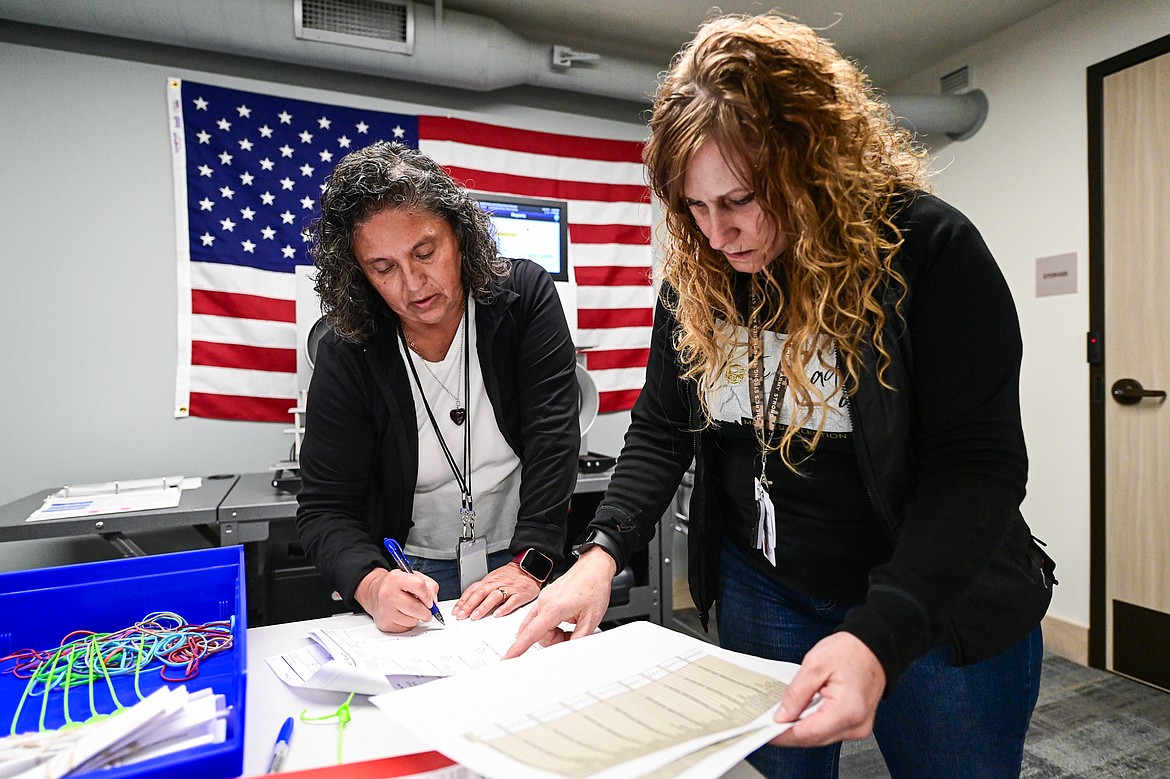
Tammy Bartos, left, and Paula Buff check the results of a batch of test ballots tabulated during a public viewing test for the 2026 Special and School District Election at the Flathead County Election Department in Kalispell on Thursday, April 23. (Casey Kreider/Daily Inter Lake)
Casey Kreider
RURAL GOVERNMENT REPORTER, REPORT FOR AMERICA Hannah Shields covers rural government and accountability reporting for the Daily Inter Lake and Northwest Montana weekly papers as part of the national Report for America program. Her reporting focuses on transparency, public spending and the impact of local government decisions on small communities. Shields has covered issues ranging from school district finances to development disputes and rural infrastructure projects. She regularly uses public records and investigative reporting to examine institutions that affect local residents. Her work helps bring greater oversight and visibility to rural government across Northwest Montana. IMPACT: Hannah’s work strengthens transparency and accountability in rural communities that often lack consistent watchdog coverage. | May 17, 2026 12:00 AM
The sound of tearing paper filled the room.
Volunteers sat around a long white plastic table, chatting with their neighbors as they tore off stub numbers along the perforated edge of each ballot in the first step of the long, tight-knit process of absentee voting.
All elections in Flathead County, except those involving federal races, are conducted by mail. Ballots are automatically sent to registered voters from the Elections Department.
Every ballot has a unique tear-off stub number that’s assigned to a voter. Elections staff use stub numbers to track how many ballots were sent out, and where the ballots were sent.
“Once the stub numbers are removed, then the voting becomes anonymous,” said Flathead County Elections Administrator Paula Buff. “But it’s our way of tracking that one to one, so that nobody ever ends up with multiple ballots.”
When a voter reports a missing ballot, an elections staff member uses the individual’s name to check for their assigned stub number in an internal data base. Once a stub number is located, staff then check the voter’s account to see if the ballot has been received and verified by the Elections Department. If not, the original stub number is voided, and a new ballot with a new stub number is issued to the voter.
A daily report tracks the number of accepted, rejected, voided and newly issued ballots in near-real time.
WHEN THE absentee ballot is returned to the Elections Department, a staff member scans a bar code on the affirmation envelope, and the voter’s profile pops up in a state database. Trained staff verify that the signature and birth year on the envelope match what’s recorded in the voter’s account.*
Once the affirmation envelope has been verified, the system records that a vote was cast for that person and blocks staff from scanning another ballot linked to that voter. This prevents people from casting more than one vote, although Buff noted it’s not a common issue.
“It’s very, very infrequent,” she said. “Maybe once or twice an election, if that.”
Most of the time, it’s people who have forgotten that they already returned their absentee ballot and try to vote in person, she said. But once a voter’s signature is verified in the system, they are blocked from voting again.
Secrecy sleeves containing the ballot are then removed from the affirmation envelope and handed off to another election staff member.
“We have no idea whose ballot it is at that point,” Buff said. “It becomes completely anonymous.”
Secrecy envelopes and ballots are not associated with a specific stub number, nor do they contain any identifying information. This ensures votes remain anonymous, even from elections workers.
A third staff member separates the ballots from the secrecy envelopes and flattens them out so they can easily run through the county’s counting machines. Ballots are then stored in sealed plastic tubs until counting begins on Election Day.
Any discrepancies in the absentee voting system are typically caused by the voter, such as forgetting to sign or write their birth year on the affirmation envelope.* Sometimes voters accidentally seal the wrong ballot in a secrecy envelope, such as one for the Flathead Electric Cooperative election, and then Buff has to notify the canvas board and record the error.
At the end of Election Day, Buff compares the total number of accepted, rejected, voided and newly issued ballots to the number ordered for each precinct or district for any major inconsistencies.
THERE’S MORE control over the absentee voting process than the polls, Buff said. She likened polling places to the “wild west” in comparison.
“We don’t have a system that is generating stub numbers [for the voters],” Buff said. “The only record of any transaction between the [election] judges and the voters exists in the register and the poll book.”
Ballots, poll books and other materials from the Secretary of State’s Office are received weeks in advance. Staff separate all the materials by precinct into metal containers, which remain sealed with numbered zip ties until Election Day.
At least two people are present when the containers head to the polls for Election Day. Upon arrival, an election judge signs off that all materials for the precinct were received.
When a voter receives their ballot at the polls, an election judge will tear off the stub number and record it with the voter’s name in a poll book. Voters also provide their printed name and signature in the register for verification.
Ballots cast at the polls are collected in secure bags and transported by at least two people to the Elections Department for counting.
VOTERS CAN currently register through Election Day, so long as they have a valid driver’s license, passport or state photo identification. Those without a Montana driver’s license or state ID must also provide documents proving their residency, such as a pay stub, utility bill or bank statement.
Election staff cannot independently verify a person’s citizenship status when they register to vote, which is affirmed by voters on the registration form. Buff directs her election staff to verbally confirm each registrant’s citizenship status to avoid unintentional mix-ups.
“Unless they can provide us with a passport or a birth certificate, there would be no way for us to verify citizenship,” Buff said. “At some point, the burden needs to be put back on the voter.”
The Secretary of State’s Office identified 23 potential noncitizens that voted in Montana elections during a recent audit of the state’s voter rolls, amounting to fewer than 0.003% of all registered voters.
Staff with the Secretary of State’s Office confirmed that at least two of those potential noncitizens indicated they were noncitizens on their voter registration forms. Several others were mistakenly registered as voters when applying for an operating license through the state Department of Motorized Vehicles.
It is rare for a person without citizenship to vote in the U.S. The Heritage Foundation, a conservative think tank, reported 100 cases of noncitizens who registered to vote in the country since 2000. That works out to less than five cases per year.
Given how rare noncitizen voting is and the additional training staff would need to review citizenship documents, Buff said she feels the current, self-affirming nature of the voter registration system is secure from noncitizen voter fraud.
“We are not the citizen police,” Buff said. “We are relying on the fact that people are telling the truth.”
Buff's bigger concern is voters participating in elections across multiple states. Only Montana residents can vote in the Treasure State’s local, state and federal elections.
The sole exception is special purpose district elections, where levies to support local schools, fire stations and other public services appear on the ballot. Landowners don’t have to be a Montana resident to cast their vote in a special purpose district election. To receive their ballot, they must provide a valid photo ID and a deed showing they own land in that district.
Montanan voters are asked to indicate if they are registered to vote in another state on their registration form. If they list that information, staff can contact the state and request to cancel their voter registration.
But there’s no automatic, nationwide system to cross reference voter records. Election staff can only request the cancellation when that information is volunteered.
With so many non-residents owning a second home in Flathead County, Buff said it’s difficult to verify whether they can legally vote in local, state and federal elections in Montana.
“We have so many people who don’t live here, who buy property here, that are from out of state,” Buff said. “How do we know whether or not they actually live here, that they’re actually a resident?”
ANYONE WITH lingering questions about elections security is encouraged to contact Buff or a member of the Elections Department staff.
Public tests of the tabulators rarely have an audience, despite being the perfect opportunity to ask questions and see how ballots are counted, Buff said. She especially encourages people to volunteer in the elections process, where they can gain hands-on experience of how the voting system works.
“If I had one wish, it would be that every person who has any kind of a question to not only come down here and watch the process, but participate in it,” Buff said. “I don’t think that people really have a good comprehension of just how much work goes into putting on an election.”
*This story has been corrected.
Report for America reporter Hannah Shields can be reached at (406) 758-4439 or [email protected]. If you value local journalism, pledge your support at dailyinterlake.com/support.
ARTICLES BY HANNAH SHIELDS
Property owners pool money build Rollins fire department's new station
Construction of the nine-bay station began in May 2025 and wrapped up earlier this year, adding approximately 9,000 square feet of garage space to the original 6,000-square-foot station.

Lakeside resort vote tabled a second time by Flathead County commissioners
Territory 1889 is a members-only resort planned to span 1,700 acres west of U.S. 93, near Blacktail Mountain.
Crews contain 1,700-acre Bras Fire near Hot Springs
A grass fire that threatened two residences and scorched 1,688 acres east of Hot Springs was fully contained Monday afternoon.