
4th District candidates talk affordability, ag and healthcare
NANCE BESTON | Hagadone News Network | UPDATED 5 hours, 11 minutes AGO
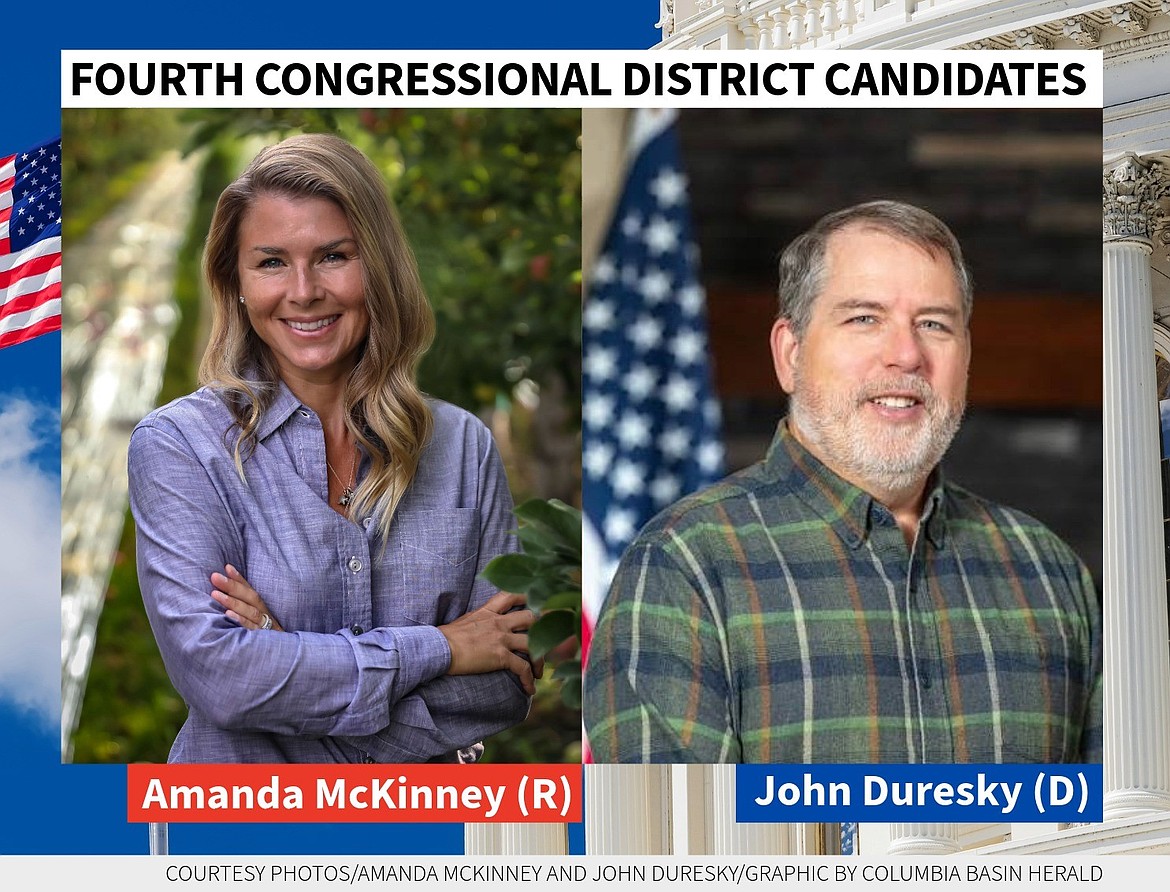
RICHLAND — Rising costs, agricultural challenges and concerns about the future of rural healthcare dominated discussion Tuesday during a candidate forum for 4th Congressional District candidates Amanda McKinney and John Duresky. The candidates presented competing visions for the future of Central Washington in the forum hosted by AARP Washington, Northwest Public Broadcasting and the League of Women Voters.
Held at the Washington State University Tri-Cities campus, the hour-long debate focused on issues affecting residents throughout the district, including affordability, Social Security, healthcare access, tariffs and economic development.
“The issues discussed today are not partisan issues. They're kitchen-table issues that affect people and families every day,” AARP Washington Advocacy Director Cathy MacCaul said.
With U.S. Rep. Dan Newhouse retiring, voters will elect a new representative for the district for the first time in more than a decade. To view the full forum, visit bit.ly/4rthCongressionalForum.
Economy and affordability
Both candidates acknowledged that the rising cost of living is top of mind for many residents.
Duresky said affordability has become a common concern during conversations with voters across the district.
“Affordability is not a buzzword,” Duresky said. “We've been all over this district, and we've talked to voters up and down the district, and we know how hard it is.”
The Democratic candidate pointed to tariffs, international trade disruptions and instability overseas as factors contributing to higher prices. He argued that Congress should play a more active role in trade policy decisions and said recent economic pressures have affected nearly every sector of the economy.
“We built a model of prosperity over the last 80 years with our trade regime, and in the last two years, it's been broken,” Duresky said.
McKinney took a different approach, arguing that energy costs and government regulation are major drivers behind increased prices.
“I'm the one who does the grocery shopping, so I know about affordability,” she said.
The Republican candidate said expanding domestic energy production and reducing government regulations would help lower costs for businesses and consumers alike.
“We can have affordable energy prices, and energy does drive up input costs across the board,” McKinney said.
The candidates later revisited tariffs during a discussion about federal trade policy. Duresky described tariffs as a tax ultimately borne by consumers, while McKinney characterized them as a negotiating tool that can be used to secure better trade agreements for American producers.
The exchange highlighted one of the larger philosophical differences between the candidates: Duresky frequently called for stronger congressional oversight and policy reforms at the federal level, while McKinney emphasized reducing regulations and encouraging domestic production.
Agriculture remains a top concern
Agriculture, the economic cornerstone of the 4th District, emerged repeatedly throughout the debate.
Asked how Congress could help address concerns about labor shortages, rising fuel costs and increasing farm expenses, McKinney pointed to labor policy and regulation as areas requiring attention.
“The H-2A worker program is an absolute godsend to our community,” she said.
McKinney said she would support expanding the agricultural guest worker program and providing greater flexibility for employers while maintaining legal immigration pathways for workers.
“We want people to be in our country legally,” she said. “That way we can bifurcate this issue from immigration.”
She also argued that agricultural producers have faced mounting regulatory burdens from both state and federal governments.
“If you have generational farmers in your family, you know this,” McKinney said. “This has been death by 1,000 cuts.”
Duresky agreed that labor availability remains a challenge and said he supports reforms to simplify the H-2A process, particularly for smaller farms.
“I certainly agree that the H-2A program needs to be refined and needs to be easier to implement, especially for the smaller growers,” he said.
Duresky said collaboration with growers, industry groups and agricultural experts would be critical in developing effective policy.
“It's not my job as a congressman to know everything,” Duresky said. “My job is to get the people on the team that can do the work.”
He also argued that tariffs have hurt agricultural producers, particularly those dependent on export markets.
“The tariffs have genuinely damaged our export markets,” Duresky said.
Though the candidates disagreed on the causes of many of agriculture's current challenges, both said supporting farmers and maintaining the district's agricultural economy would be among their priorities if elected.
Social Security and retirement security
Social Security also received significant attention during the forum, reflecting concerns among older voters throughout the district.
According to AARP Washington, voters age 50 and older accounted for more than 55% of the electorate in the 4th Congressional District during the 2024 election, making retirement-related issues particularly important.
Duresky said protecting Social Security should be a congressional priority.
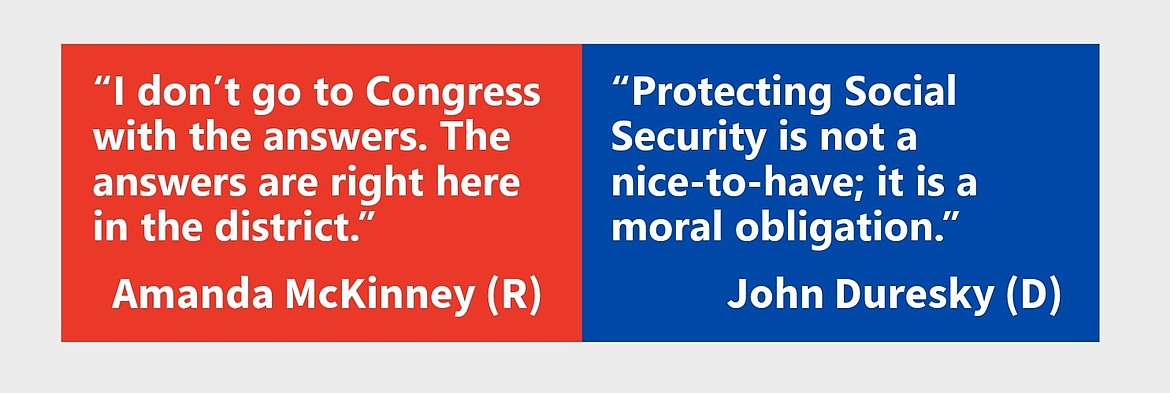
“Protecting Social Security is not a nice-to-have; it is a moral obligation,” he said.
He proposed eliminating the payroll tax cap so higher-income earners would continue paying Social Security taxes on wages above the current threshold.
“The first thing that we have to do right away is, we have to remove the payroll tax cap,” he said.
McKinney also expressed support for maintaining Social Security benefits but argued Congress should take additional steps to prevent fraud and misuse of government funds.
“My parents are receiving Social Security, and it's been something that even my generation has talked about,” McKinney said. “Are we going to see it?”
Drawing on her experience in county government during the COVID-19 pandemic, she described efforts to identify fraudulent rental assistance applications and said similar scrutiny should apply to federal programs.
“When you look for fraud, it means that the money actually goes to the people who deserve it,” she said.
Differing healthcare approaches
Healthcare generated one of the most substantive exchanges of the evening, particularly regarding the future of rural hospitals.
Duresky expressed concern about reports suggesting some rural healthcare facilities could face financial pressure from proposed Medicaid changes.
“If a hospital leaves one of these small local communities, that local community is going to dry up,” he said.
Duresky said he has spoken with healthcare workers and hospital administrators throughout the district and believes access to care remains a growing challenge in rural areas.
He argued that federal reimbursement rates need improvement and warned against policies that could result in more people losing health insurance coverage.
“Fixing that on day one is going to be the biggest job when we get there,” Duresky said.
McKinney agreed rural healthcare systems face significant challenges but said the problems extend beyond recent federal policy debates.
“We have actually had a rural healthcare issue not only here in Central Washington, but across America, building and building for several decades,” she said.
McKinney highlighted local efforts aimed at training and retaining healthcare providers in rural communities and suggested additional incentives could encourage more providers to practice outside urban areas.
“I think a lot of providers would want to come to communities if they knew they didn't have a huge expense waiting for them,” she said, referring to student loan debt.
The discussion reflected another broader difference between the candidates. Duresky emphasized federal reforms and increased support for healthcare programs, while McKinney focused on locally driven solutions and workforce development.
Energy and the district's future
Both candidates also discussed energy development and the economic opportunities it could bring to the region.
McKinney voiced strong support for expanded nuclear energy production, arguing that Central Washington's existing infrastructure and proximity to Hanford position the area for future investment.
“We have a monumental opportunity to bring massive job and infrastructure into our community,” she said.
Duresky likewise acknowledged the importance of energy development but stressed the need for local oversight and protections for communities as new projects are considered.
Both candidates portrayed themselves as advocates for rural Central Washington but offered differing approaches to achieving many of the same goals.
McKinney repeatedly emphasized local control, reduced regulation and solutions driven by residents themselves.
“I don't go to Congress with the answers,” she said. “The answers are right here in the district.”
Duresky focused on oversight, collaboration and bipartisan problem-solving.
“There's a lot of things we can do if you put politics aside, if you put ideology aside, and you look for real improvements,” he said.
Voters will choose between McKinney and Duresky in November as they seek to represent Washington's 4th Congressional District in Congress and succeed Newhouse.
ARTICLES BY NANCE BESTON

Kratom restrictions begin in Moses Lake today
MOSES LAKE — A new Moses Lake ordinance restricting access to kratom products for people under 21 takes effect today, adding age restrictions and new requirements for retailers who sell the products. The ordinance, approved by the Moses Lake City Council on July 28, prohibits the sale, distribution or advertising of kratom products to anyone younger than 21. The law applies to products containing kratom, kratom extracts, mitragynine, 7-hydroxymitragynine and synthetic kratom-derived compounds.
4th District candidates talk affordability, ag and healthcare
RICHLAND — Rising costs, agricultural challenges and concerns about the future of rural healthcare dominated discussion Tuesday during a candidate forum for 4th Congressional District candidates Amanda McKinney and John Duresky. The candidates presented competing visions for the future of Central Washington in the forum hosted by AARP Washington, Northwest Public Broadcasting and the League of Women Voters. Held at the Washington State University Tri-Cities campus, the hour-long debate focused on issues affecting residents throughout the district, including affordability, Social Security, healthcare access, tariffs and economic development. “The issues discussed today are not partisan issues. They're kitchen-table issues that affect people and families every day,” AARP Washington Advocacy Director Cathy MacCaul said.

Homesley, Falstad outline priorities for improving Auditor’s Office
EPHRATA — As Election Day approaches, voters are considering not only who should lead county government offices, but how those offices can better serve the public through transparency, accessibility and efficient service. For the final installment of the Columbia Basin Herald’s five-part candidate Q&A series, auditor candidates Shannon Falstad and Darci Homesley were asked: “Grant County residents expect government offices to be efficient, transparent and accessible. What's one area where the Auditor's Office is falling short today, and how would you address it differently than your opponent?” Falstad: I do not believe the Auditor’s Office is currently falling short in these areas. In fact, there are already several ways the office provides accessible service to the public. For elections, the public can observe the election process. For licensing, residents have access to two subagents-Winzler Licensing in Moses Lake and Petersen Licensing in Quincy-which provides additional convenience and accessibility. For recording, the office accepts electronic recording, and the public can access the index through Eagle Web. That said, there is always room for improvement and welcome feedback from residents and employees. Listening to the people we serve and being willing to make improvements when needed is an important part of keeping county government efficient and accessible.