Bull Lake developer's plan draws ire of county locals
SCOTT SHINDLEDECKER | Hagadone News Network | UPDATED 4 months AGO
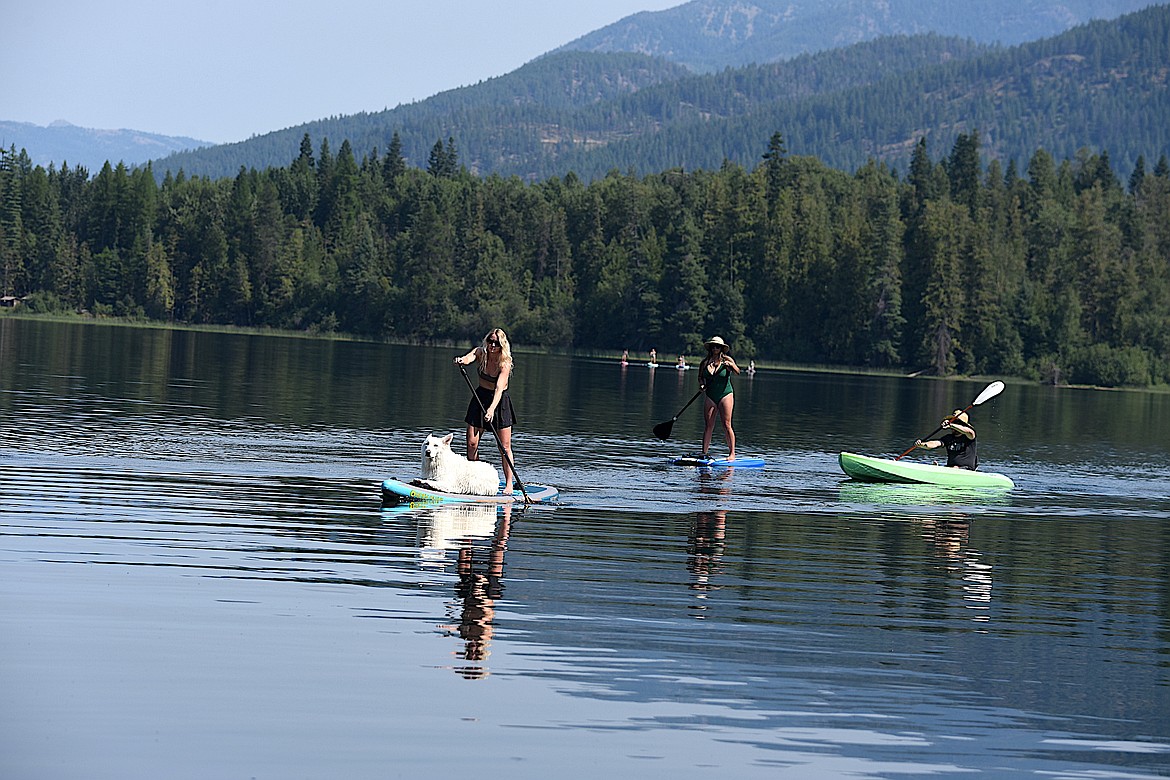
Paddle boarders and a pooch enjoy the calm waters of Bull Lake Friday, Aug. 2, 2024. (Scott Shindledecker/The Western News FILE)
Does this plan even make sense?
A proposal to develop home sites on Bull Lake wetlands in Weasel Gulch has drawn the ire of some local residents.
Long-time developer James Beasley submitted an application to the U.S. Army Corps of Engineers for the Fish Hook Subdivision in the original Bull Lake Estates plat because wetlands would be affected.
Beasley’s plan calls for seven lakefront residential lot sites on the undeveloped northern parcel, which is on private land.
The application also states that the project area has three wetland habitat types. Two, containing about 6.5 acres, is described as “seasonally flooded” while a third type, 5.6 acres, is “seasonally saturated.”
The Corps of Engineers is taking public comment on the proposal and the deadline to submit one is Thursday, June 18. Electronic comments may be sent to Commander Nathan Green at [email protected] or https://rrs.usace.army.mil/rrs. Written comments may be submitted to Commander, U.S. Army Corps of Engineers, Omaha District, Attention: Nathan Green, 1600 North Ave. West, Suite 105, Missoula, MT 59801. Writers are asked to refer to the permit number, NWO-2002-90609-MT.
Beasley cites the growing demand for permanent and seasonal housing for the development.
Opponents say the road in the development would require a substantial amount of fill and would cause lasting harm as well as invite invasive species. There is also concern for how the sewage from any residences would be handled.
A few Bull Lake property owners spoke of their concern for the potential harm that could result from the development.
One was Gloria Beasley. She was married to Robert Beasley, known to most as “Bob.” He was Jim’s father.
“I’m upset because it’ll damage our lake,” Gloria said. “I don’t know where they would pump the sewage.”
Gloria explained her knowledge, due to Bob’s involvement, of some of the development that occurred on Bull Lake.
She said that the original subdivision was divided between the three principals, Bob, Gloria and Jim.
“When the Bull Lake Estates subdivision was done, the state told us what a great job we did, but with this one, I just don’t know where it’d go.
“Where he wants to put that new subdivision in, it has a nice sandy beach there and that would be very attractive to people,” Gloria added.
She also spoke of how the land in question ended up belonging to Jim Beasley.
“After my husband (Bob) died, I didn’t realize we still owned land on the lake, but Jim wanted to buy it. When I said I wouldn’t sell it, he threatened to sue me. Jim had also told others the land was worthless anyway.
“I checked with a local surveying company and I was told there was no way that property would be developed, so I ended up selling it to Jim,” Gloria said.
Another thing that opponents of the proposed development say should stop it is a covenant that Jim Beasley signed in 2003
According to the document that was filed in Lincoln County, in exchange for placing fill material for the development, the land currently in question would be dedicated for perpetual use as a conservancy area. It also states that the covenant, “shall run with the land and be binding on the permittee (Jim Beasley, President, for Bull Lake Estates, LLC) and its successors and assigns forever.”
The deed and use restrictions in the covenant are also lengthy and are meant to prevent filling the property, road building and construction or placement of buildings or other structures.
The covenant also states that for it to be changed, the Corps of Engineers must provide written approval, which is where the matter currently stands.
In his plan for building a road, Beasley states that 526 cubic yards of road subgrade and 88 cubic yards of crushed surface are needed as well as 26 cubic yards of pre-cast concrete for the retaining walls and another 80.5 cubic yards of fill for “secondary disturbances.”
They also say Beasley offered a more practicable alternative, building a bridge would avoid a large amount of the impact.
Beasley spoke briefly to The Western News about the permit.
“It’s all up for review and we’ll see what they (Corps of Engineers) have to say,” Beasley said. “If they approve it and I decide to go through with it, then it would come to the county and DEQ before anything happens.”
While litigation has not commenced in Beasley’s latest project, it did occur 21 years ago when he was working on the original Bull Lake Estates subdivision.
A small group, “Friends of Bull Lake,” filed a suit against the Lincoln County Commissioners and Beasley, as an intervenor, after the commissioners failed to follow standards and mandatory procedures in the Montana Subdivision and Platting Act (MSPA). They also asserted that an environmental assessment did not comply with the MSPA and the commissioners acted contrary to public notice and hearing requirements of the platting act.
Flathead County District Judge Katherine Curtis issued an April 19, 1996, ruling that supported Friends of Bull Lake’s arguments.
Beasley said previous development in the early 2000s in the original subdivision resulted in 0.46 acres of permanent wetland disturbance. He said that was mitigated by wetland restoration and deed restrictions on some parts of the wetlands.
Keegan Warrington, who owns property on the other side of the lake, has launched a campaign opposing Beasley’s development plan.
“This developer signed and recorded a permanent covenant agreeing this land would not be developed and now he's working to undo that promise so he can develop it anyway,” Warrington said in an email to The Western News. “That covenant wasn't optional; it was the condition placed on him after earlier work here. If a permanent conservation commitment can just be reversed the moment it's profitable enough to do so then what's the point?”
Beasley, in the application, reported that 2.59 acres of wetlands were deed restricted. To develop it, the restriction needs modified. He also proposed a deed restriction on remaining wetlands within Lot 2, resulting in a net gain of 5.7 acres from the original deed restriction.
Warrington was also concerned about water quality and how wastewater would be disposed of.
“This is a permanent impact on a wetland that right now is untouched and functioning, it's part of what keeps the lake healthy. No amount of mitigation changes the fact that this is a development on that wetland and there's still no clear picture of how wastewater would be handled or what protections would actually be required,” Warrington said. “Ultimately, the responsibility to maintain the wetland and meet the Corps' standards would fall on the developer to uphold over the long term and given the history here, I have real doubts that this will happen. Once a wetland like this is degraded, you don't get it back.”
Another issue is the alleged presence of French drains where the northeast/north lots are located.
Beasley said he did not recall the presence of the drains.
The late Mark Agather, who died in June 2025 and helped form Friends of Bull Lake more than 20 years ago, wrote a letter, dated Dec. 30, 2024, to the current group opposing the potential development. It painted a less than flattering portrait of Jim Beasley.
“No issue involved more of our time than that of the drainage of waste into the wetlands on the northern part of his development,” Agather said. “It was so hard dealing with a person like Beasley whose only goal was to get a development to make money in the easiest fashion he could.
“We made it clear from the very beginning that we did not oppose the development of this piece of property but we wanted it done according to subdivision law, water quality law, and with appropriate testing to make certain that its impact on the lake and the purity and quality of our water was not adversely impacted.”
Agather, in his 2024 letter, also wrote that, “the French drains located under the fill where the northeast/north lots are located must go. They are illegal according to wetland law because they are draining affluent and other materials into a wetland.
“Beasley’s weakest link is the drain pipes located under these proposed lots. Fines for allowing them to continue could run into the millions.”
Montana Department of Environmental Equality, the certifying agency, will review the proposal with the intent to certify in accordance with the provisions of the Clean Water Act.
ARTICLES BY SCOTT SHINDLEDECKER

Libby Loggers get much-needed win over Ronan